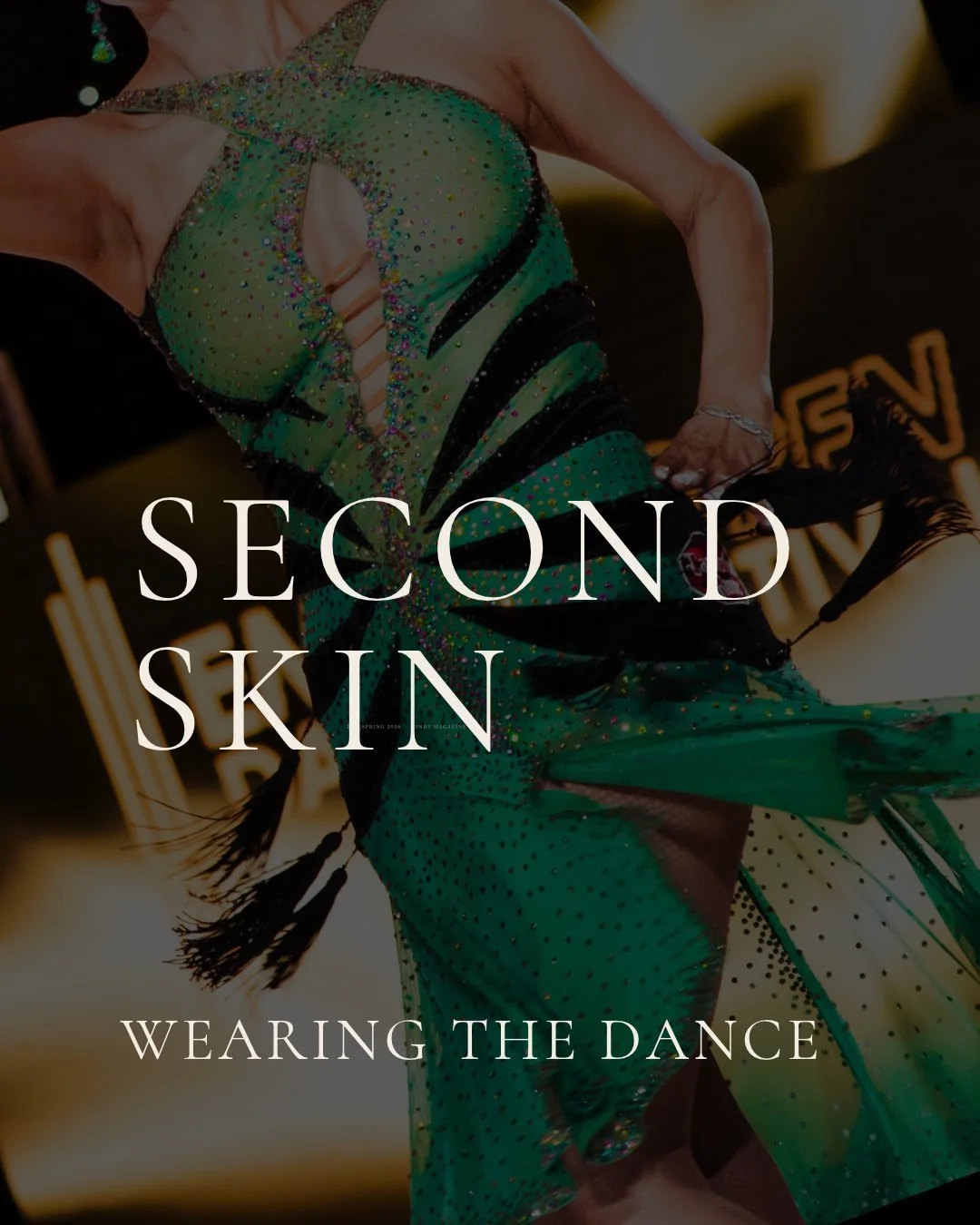
Under competition lighting, fabric extends the body. Rhinestones ignite. Mesh dissolves. Color intensifies beyond what daylight permits. What looks excessive up close becomes precise from across the floor.
This column examines ballroom dress not only for its details and fabrication, but for its function. These garments are engineered for motion, for the amplification of the body, and for the visibility of technique. The question is not why ballroom costumes look dramatic. The question is why they must.
The Dress: Emerald Rhythm
Cut in a vibrant emerald stretch mesh and black velvet, the dress was originally designed for a professional dancer competing at the Emerald Ball DanceSport Championships in Los Angeles, organized annually by Wayne and Donna Eng.
Across the bodice and torso, the bands of black velvet radiate outward through the emerald mesh in a series of directional lines that hugs and accentuates the body, given it shape. It is these velvet bands that give the dress its most striking quality. The darker velvet creates contrast against the luminous green, guiding the eye toward the center of the body and emphasizing the dancer’s shape from across the floor.
Stones scatter across the mesh, shifting color as the body moves — sometimes golden, sometimes pink, sometimes violet — catching light, and eyes, from different angles of the ballroom.
The skirt is constructed as an eight-panel fluted silhouette designed for motion. Crystals placed along the hem add weight so the fabric swishes faster through turns and wraps around the legs at the end of a spin, allowing the movement of the body to remain visible from a distance.
Originally created for a Rhythm dancer, the dress prioritizes danceability. The skirt can be lifted and shaped through the music in solo moments, while tassels added at the hip introduce a second layer of movement that echoes the rhythm of the steps.
After its debut on the professional floor, the dress was eventually returned to the designer’s atelier. For its second life on the floor. •
Photography by Jennifer Bladel · From CINDY Issue No. 1, Spring 2026. Read the full issue