THE OBJECTIVE EAR
•
THE OBJECTIVE EAR •

The Changing of the Guard
Passing the baton to the next generation gets personal: Cindy Gallagher on her first Thanksgiving as a guest.

Table Rituals
The Changing of the Guard
Passing the baton to the next generation gets personal.
Thanksgiving 2025
I had just returned from Ohio Star Ball, excited, emotionally raw, and physically exhausted. I was trying to make sense of my fourth-place finish in Rhythm! I don’t know how I managed that! I was happy and grateful for the experience. It had been quite a year of dancing.
Thanksgiving was a week away.
Normally, starting the Thanksgiving preparations this late in the game would have been cause for a great deal of distress.
Thanksgiving in our household is not a casual affair. I create menus, compile shopping lists, source and select ingredients, and dust off my collection of cookbooks and magazines accumulated over the years. Then there is the great Thanksgiving binder to review.
As far as family entertaining is concerned, Thanksgiving is the big one.
This year, however, it would be different. Weeks earlier, my youngest son, one of the boys, had offered to host Thanksgiving with his girlfriend at their new apartment. I was delighted, intrigued, and curious about the idea. But if I am to be completely honest, I could feel a certain apprehension building up.
His offer also meant I could compete at Ohio Star Ball, scheduled just a week before Thanksgiving. A non-starter if I were hosting.
I found myself torn. Did I want to prepare Thanksgiving dinner, or did I want to dance?
In 2006, after I remarried and settled into our new home, we started creating our own unique version of our Thanksgiving traditions. That first year, I was in overachiever mode. I prepared three different turkeys, each with its own flavor profile and accompanying gravy. I had three stuffings, plus a succulent brisket, a tribute to my husband’s Arizonan family traditions, and a baked ham complete with pineapple and cherries, a tribute to my side of the family.
I made all the dishes, and it took me almost a week to recover from such culinary extravaganza.
Over the years, the feast has evolved into a familiar repertoire: a fresh turkey from the specialty poultry farm, two stuffings, mashed potatoes, gravy, cranberry sauce, Waldorf salad, a couple of side dishes, one of which has to include some version of corn, a pumpkin pie made by my husband, and an apple pie made by my youngest son.
I serve the feast with a full formal table setting, including name cards assigning seats, and the most important items on the table: the menu cards. The guides outlining the gastronomic journey the guests are about to embark on.
This time, however, I only had to make one dish to bring to the Thanksgiving feast: the sausage and apple stuffing.
So this Thanksgiving, I stepped back and allowed myself to be a guest. I thought I would find the transition unsettling, but to my surprise, I rather enjoyed experiencing this sweet reversal of roles.
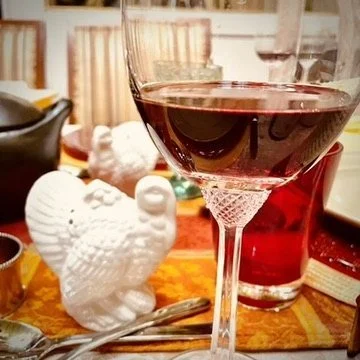
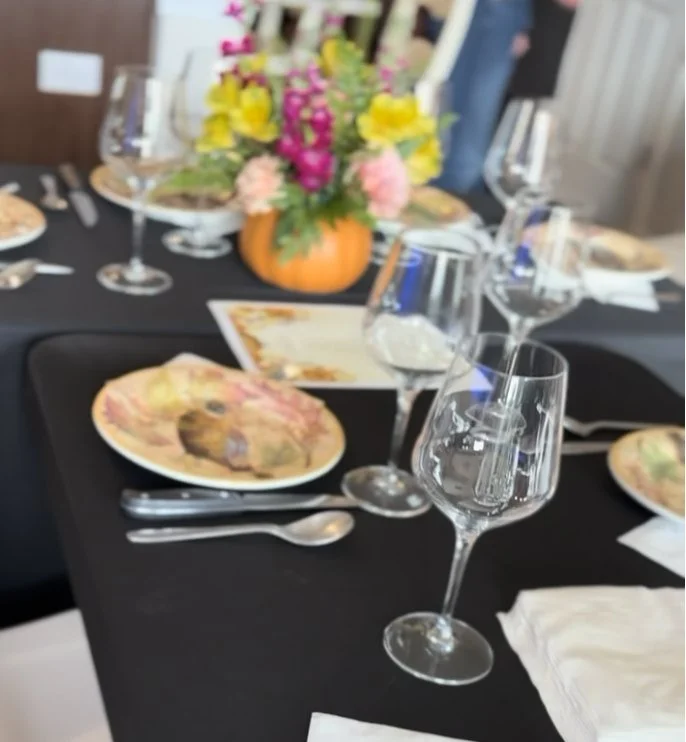
I sat down at this young couple’s table and took it all in. The carefully arranged place settings and name cards. The wine glasses. The pumpkins and flowers. The kitchen island filled with delectable dishes, some new, some old, and the printed menu cards!
They had created something familiar, and yet I felt the arrival of a new era.
And while they haven’t agreed to host the next Thanksgiving, the rest of us have. •
Credits & Sources
Photography: Cindy Gallagher
From CINDY Magazine, Issue No. 2, Fall 2026. Read the full issue

Black Coffee
Kristi Nadvornik and Mayo Alanen’s show dance, and the fifties glamour behind the dress.
Glamour Girl!
A Story of Fashion, Music and Dance
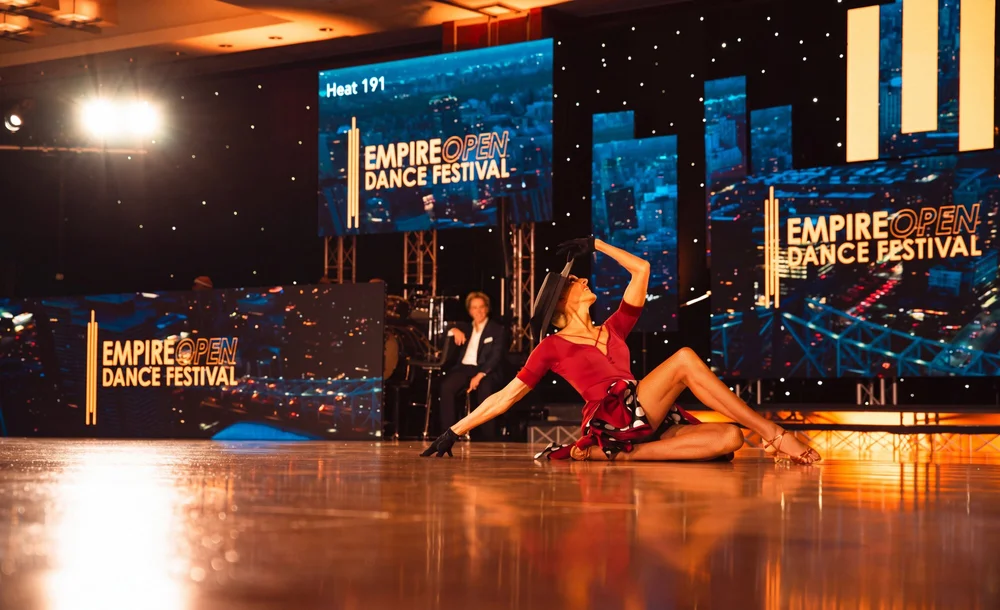
On an empty ballroom floor, the dancers’ blank canvas, Kristi and Mayo created a world that existed for ninety fleeting seconds. And in that brief moment, they took me, the eager observer, on a journey of imagination and discovery.
PART ONE: Infatuation
In 2025, the Ohio Star Ball Dance Competition felt like the grand finale of the fireworks that had been my first year on the DanceSport circuit as a Pro-Am student.
It started in July, with the Empire Dance Festival in New York City, my very first competition. Capital in Washington, D.C., followed, and then it was on to Orlando, to the mother of all competitions: the United States Dance Championships. By then, I was thoroughly captivated by the world I had discovered the year before, on one spring afternoon.
Ohio was a whirlwind. In and out: arrive one evening, Rhythm early the next day, Smooth the morning after, and then home. Quick and efficient, before my Thanksgiving preparations fell out of step with the traditions I had developed over a lifetime of holiday planning. Never mind that this would also be the first year my youngest son and his fearless girlfriend would take over the family Thanksgiving feast. Surely, your adult children still need your steady hand and the wisdom of years to properly dress the turkey. No?
During my first hours in Ohio, as is usually the case for me, I felt dizzy trying to get my bearings in the new environment, absorbing the pulse of competition, and experiencing what this new place had to offer. My two days at the competition vanished in the blink of an eye, and suddenly, I was back at the airport. Veni, vidi, vici?
But the statuesque Kristi Nadvornik, a Mayo Alanen’s student and my new Rhythm Bronze sister, remained in Ohio. I knew she was staying to compete in the legendary Best of the Best Show Dance, and thankfully, the event would be livestreamed. Thank you, Ohio Star Ball!
When the time came for Kristi's show dance, I was back in New Jersey, driving home from the school drop-off, so I pulled onto the shoulder of the road, the lane reserved for emergencies. This was, after all, an emergency. I could not miss Kristi.
And I was rewarded with a performance that captured my imagination.
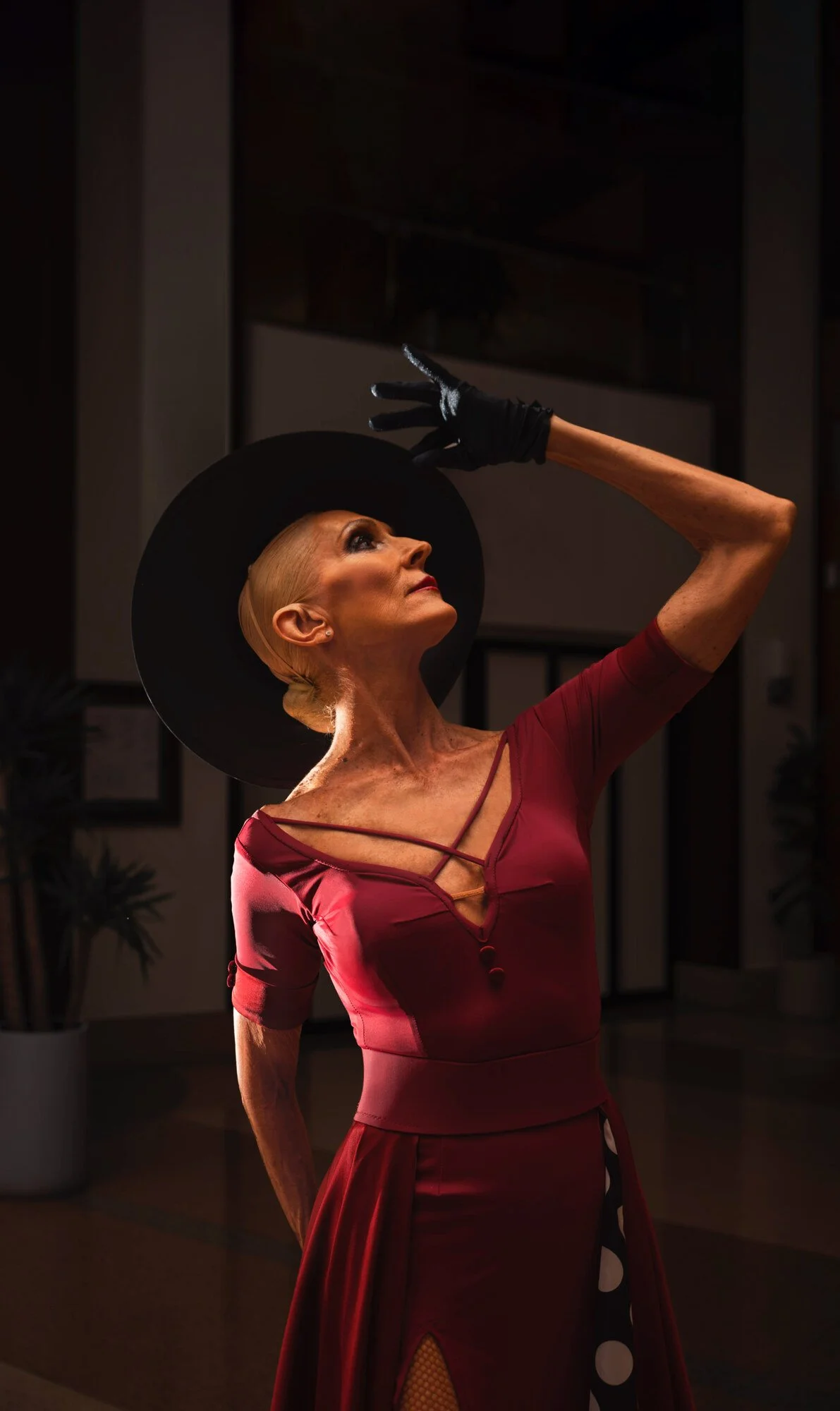
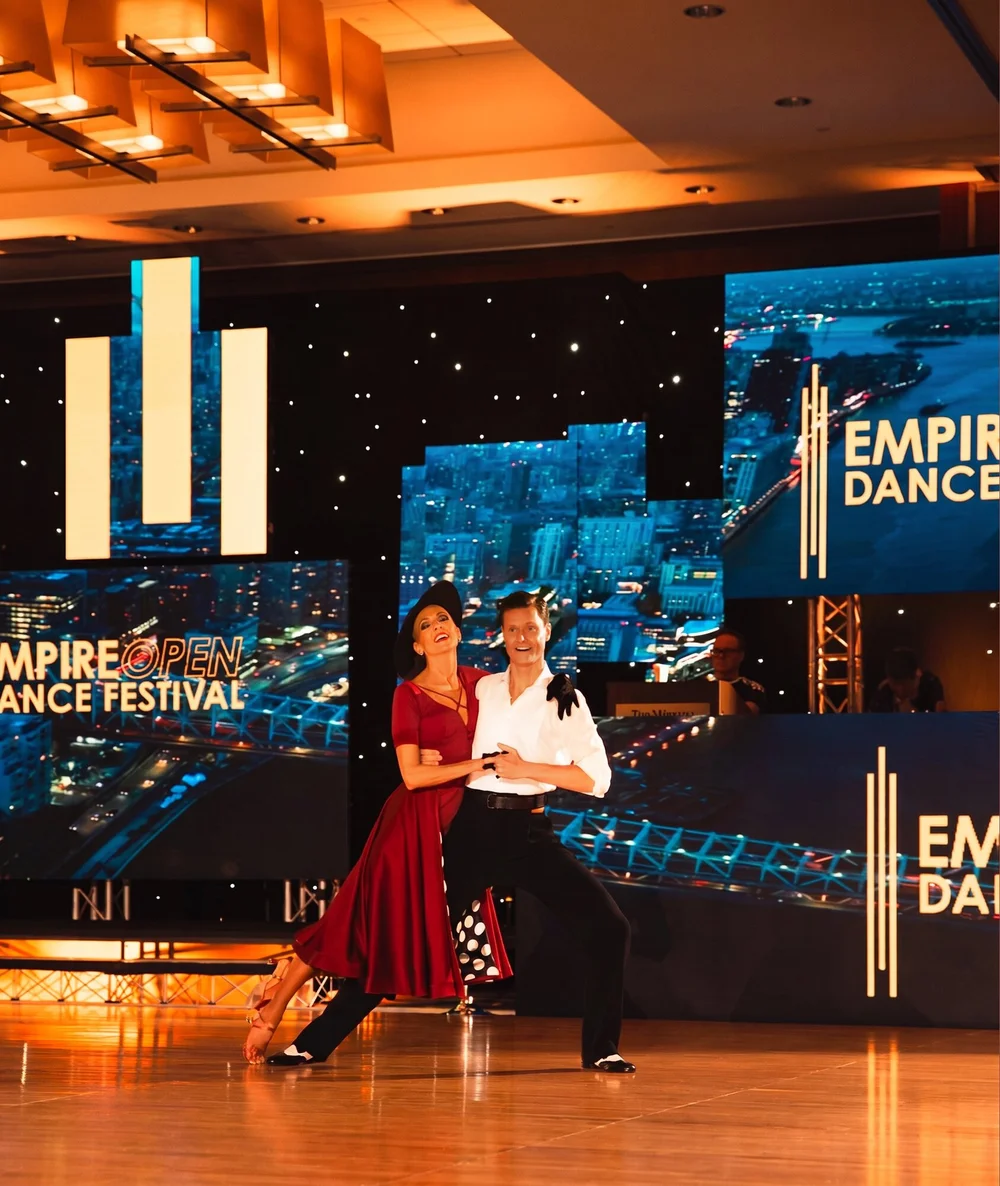
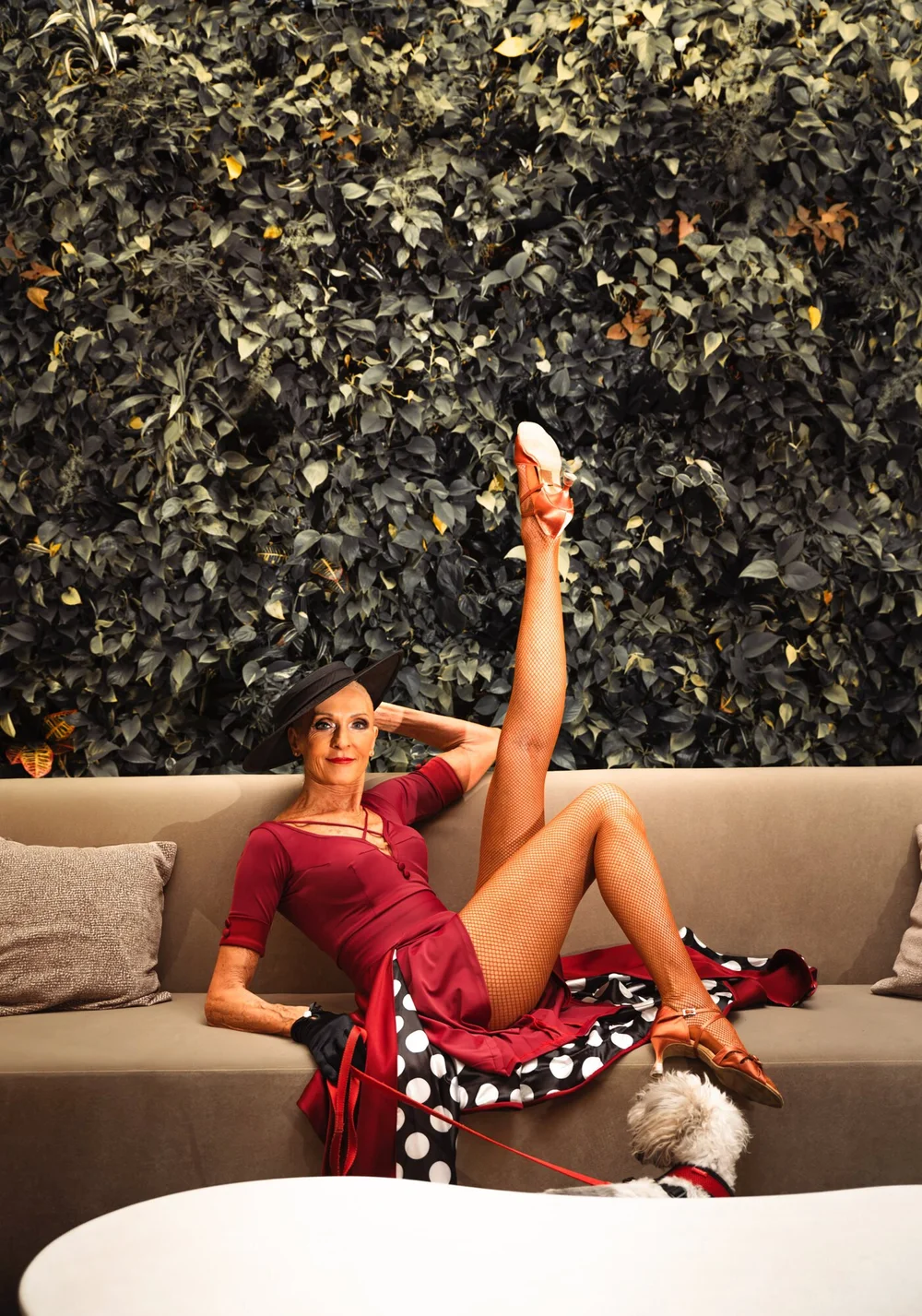
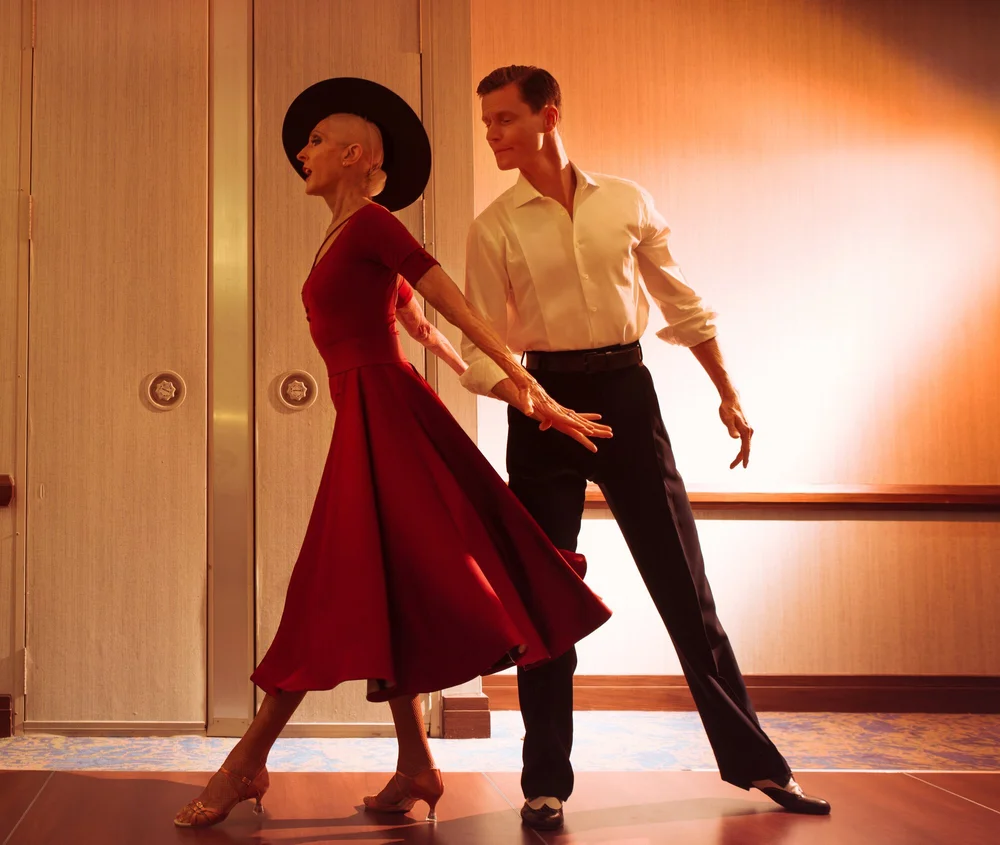
Kristi and Mayo appear on the floor. Slowly, he made his way toward her. She moved with a sensual, almost gooey walk, as though the music itself were inviting her in. And then: Oh, what a dress!
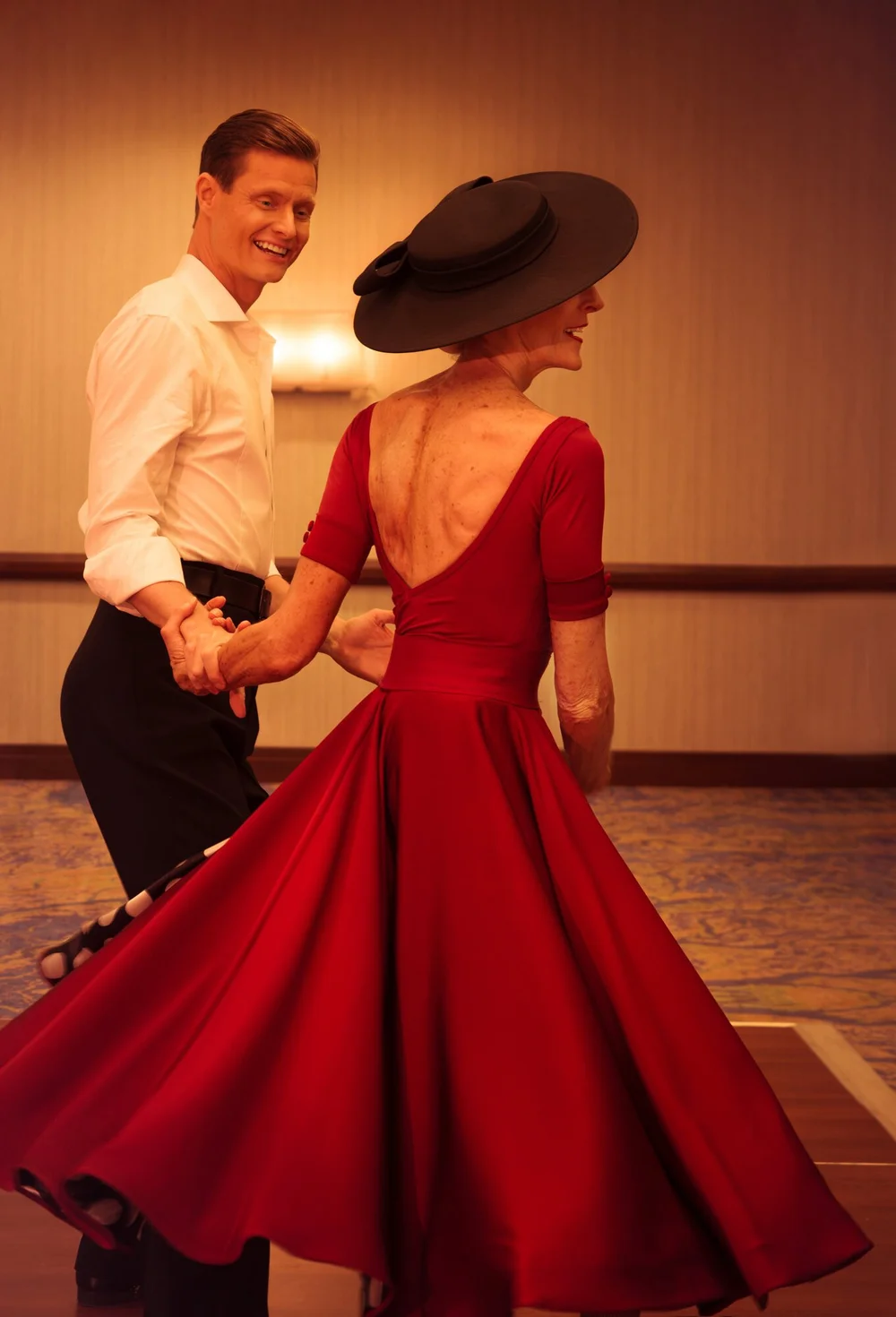
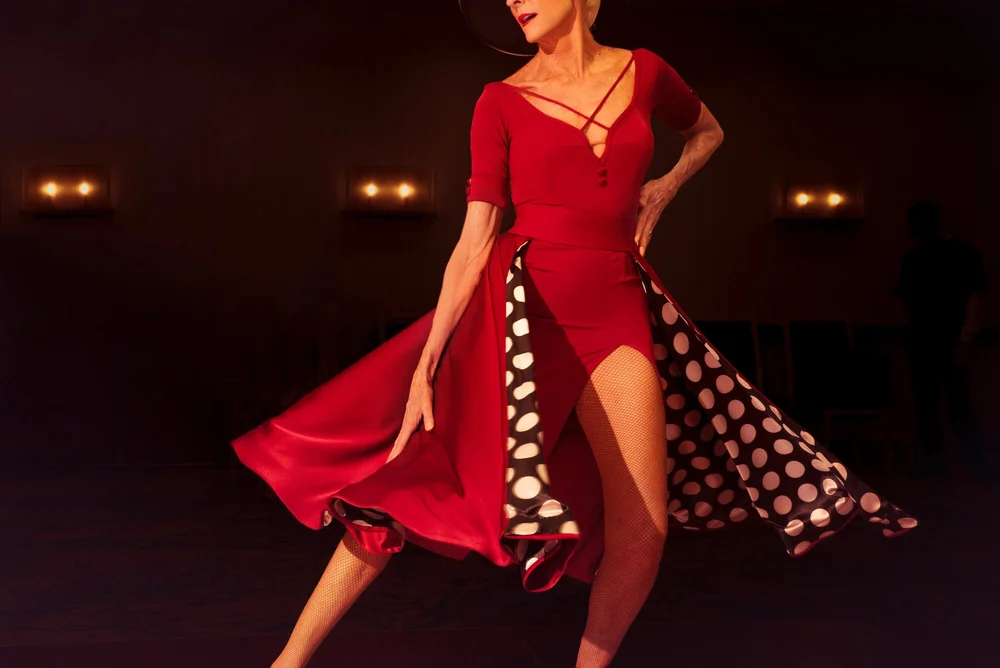
The dress said it all. A fitted bodice. A narrow waistline. A full, flowing skirt. The hat. The gloves. A figure eight: Corolle and En 8. I recognized that silhouette immediately!
To me, it echoed Christian Dior's New Look, introduced in Paris in his inaugural 1947 collection and immortalized in the famous Bar ensemble.
I have followed fashion and the great couture houses for years, acquiring perhaps more hardcover books on their histories than I care to admit. Dior is no exception. Who hasn't read Marie-France Pochna's Christian Dior: The Man Who Made the World Look New? watched the documentary Dior and I, or seen the television series The New Look? Right?... Right?
This show dance was love at first sight. The dance continued to replay in my mind in the days and weeks that followed. Naturally, I wanted to know how this idea had come to life. Where had the dress come from? Was Dior really part of its story, or was that something I had brought to it myself? What music was this? And how had a Pro-Am couple taken all of these elements and turned them into such a mesmerizing performance?
Months later, on an April afternoon, I sat down with Kristi at the Metropolitan Museum of Art's chic Balcony Lounge, sipping a refreshing Masterpiece Martini, one of the lounge's signature cocktails, to find out more about how this dance came to be.
II. The Interview
The Idea
Where did the idea or inspiration for Black Coffee come from?
“I knew I wanted to do something from the fifties. That was the decade I was born in. And I wanted to do something kind of gooey.”
Gooey. The word that describes it all. An adjective that can mean soft, wet, sticky, or sentimental. Like a toasted marshmallow melting in your mouth as you sit around a bonfire, remembering the adventures of the day.
Gooey. A piece intended to have this quality would have to reveal its personality through the music, movement, visual effect, and the entire atmosphere of the performance.
“My previous show dance was in 2023, at Ohio Star Ball's Best of the Best. It was in memory of Ryan, my partner of twenty-five years, who had passed away just a few months earlier. I called it Ryan's Song, but the music was actually Angelina Jordan's cover of ‘Bohemian Rhapsody.’ It was a beautiful experience.
“With Black Coffee, I took a much more active role in the creative process. After I found the music, I looked for ideas for the costume; I found the fabric; I sourced the accessories. It was the first time I was involved at this level of intensity.”
The Music
How did you choose the music?
“I did research for it. I saw this performance on Facebook where Carrie Underwood, Christina Applegate, and Kristin Chenoweth, a very big Broadway star, sang this medley of songs from that time period. They were all dressed up with blonde fake wigs and pink dresses, and they were hilarious!”
“I just loved it, and I thought, why don't we combine songs and make it a little different from just one piece of music?”
“I found music from the fifties that had a certain feel. I put together three different options, each combining two or three songs. Each had a slightly different quality. We only had ninety seconds for the performance at Ohio Star Ball, so we took the music to Diana McDonald, who created the most amazing arrangement.”
Diana McDonald is a World 10-Dance Champion, choreographer, coach, and longtime figure in American DanceSport. She co-owns Rogers Dance Center and is active in organizing competitions.
“As Diana listened to these pieces of music, she said, ‘You know what I hear? I hear a conversation between a woman and a man.’ Diana is amazing. She took Peggy Lee's ‘Black Coffee,’ and then she pulled in T-Bone Walker's ‘Glamour Girl,’ the part where he sings ‘glamour girl, glamour girl.’ You hear those lyrics interspersed throughout the Black Coffee show dance.”
“She blended it so well. I don't know how she did it, but she did it!”
Later on, I discovered that “Black Coffee” was written in 1948, with music by Sonny Burke and lyrics by Paul Francis Webster. Interestingly, before becoming a lyricist, Webster had worked as a dance instructor at an Arthur Murray studio in New York City! Those dance people and their many talents…
The Dress and Its Inspiration
Where did you find inspiration for the dress?
“I knew it had to be something from the fifties, so I started looking online for inspiration. I found ideas for the dress, the hat, the gloves, everything. I even came across a seamstress on Etsy and considered reaching out to her, but I wasn't sure she understood ballroom costumes. I needed more than just a dress. The dress had to stretch, look right, and be appropriate for ballroom dancing. The search itself was so much fun, and I really got so much out of being so involved in the creative process.”
So Kristi worked with Dawn Smart at Doré Designs. Kristi has had a long relationship with Doré, going back to when she first started ballroom dancing fifteen years ago. Fifteen years! She reached the Open Gold level in American Smooth in 2016, after four years in Silver. She is an accomplished “smoothie.” But this was her first year trying American Rhythm.
“Except for my first gown, which I bought second- or third-hand, I've gotten every gown from Doré. My first few dresses were off the rack, and then I started going custom. Dawn was so creative with me, and I really learned to trust her.”
And then I had to ask the question that had been needling me since I first watched the performance on my iPhone, pulled over on the side of the road that Friday afternoon.
The image that had come to mind as I watched her gooey, silky movements unfold to the sticky notes of the arranged Black Coffee music.
Was Christian Dior part of your inspiration?
“No. My inspiration was the fifties.”
A memory, a feeling of the past. A hint of a time when fashion was influenced by Dior. Not just influenced. In the fifties, Dior shaped the fashion culture of the era.
For Kristi, born in the wake of Dior's fashion revolution, his influence was simply woven into the fashions she grew up with and was now seeking to recreate.
Tell me more about how the dress came to be.
“I sent Doré pictures of the ideas I'd found on Etsy. I was just looking for inspiration. I worked mostly with Cecilie Pope, who's been with Doré for thirteen years. Cecilie is amazing. She studied art and fashion design at Mount Holyoke and Parsons. She discovered that Rosemary Clooney wore a similar style of dress in White Christmas. And I didn't even know that!”
Making the Dress
How did you decide on the fabric and finishing details?
“First, I wanted a shiny fabric. I bought some shiny Lycra and made a practice skirt myself. But when I saw the finished skirt, I didn't like it. It didn't look good in shiny fabric. It was just bad! And I was like, I don't want shiny anymore!”
“When I asked Diana McDonald about the shine on the fabric, she said, ‘You don't want too much shine, because the costume itself is going to be what gets the attention.’”
“Once I talked to Cecilie and Doré, they found the fabric. They actually used the reverse side of the Lycra, the side that wasn't shiny. That's how we came up with it.”
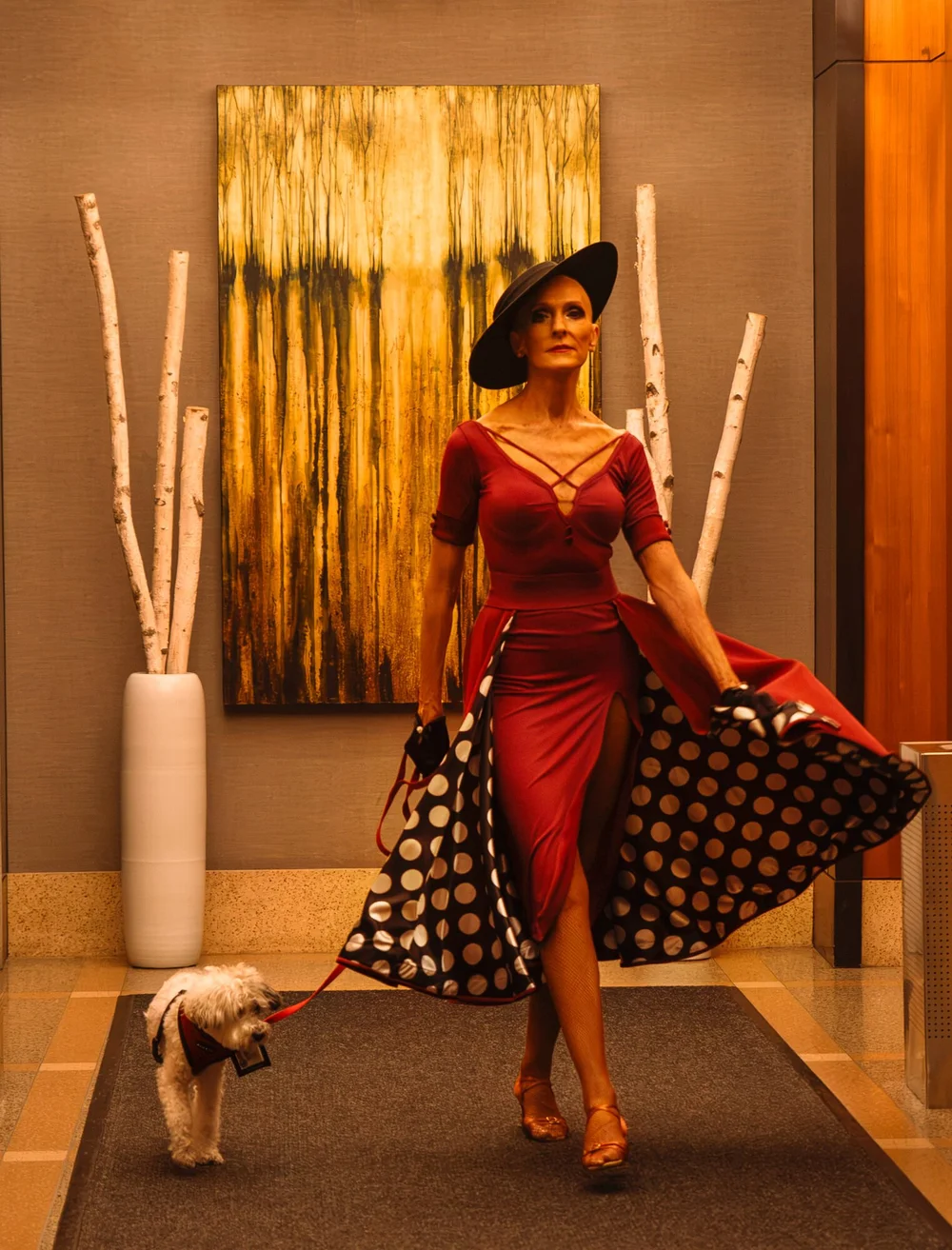
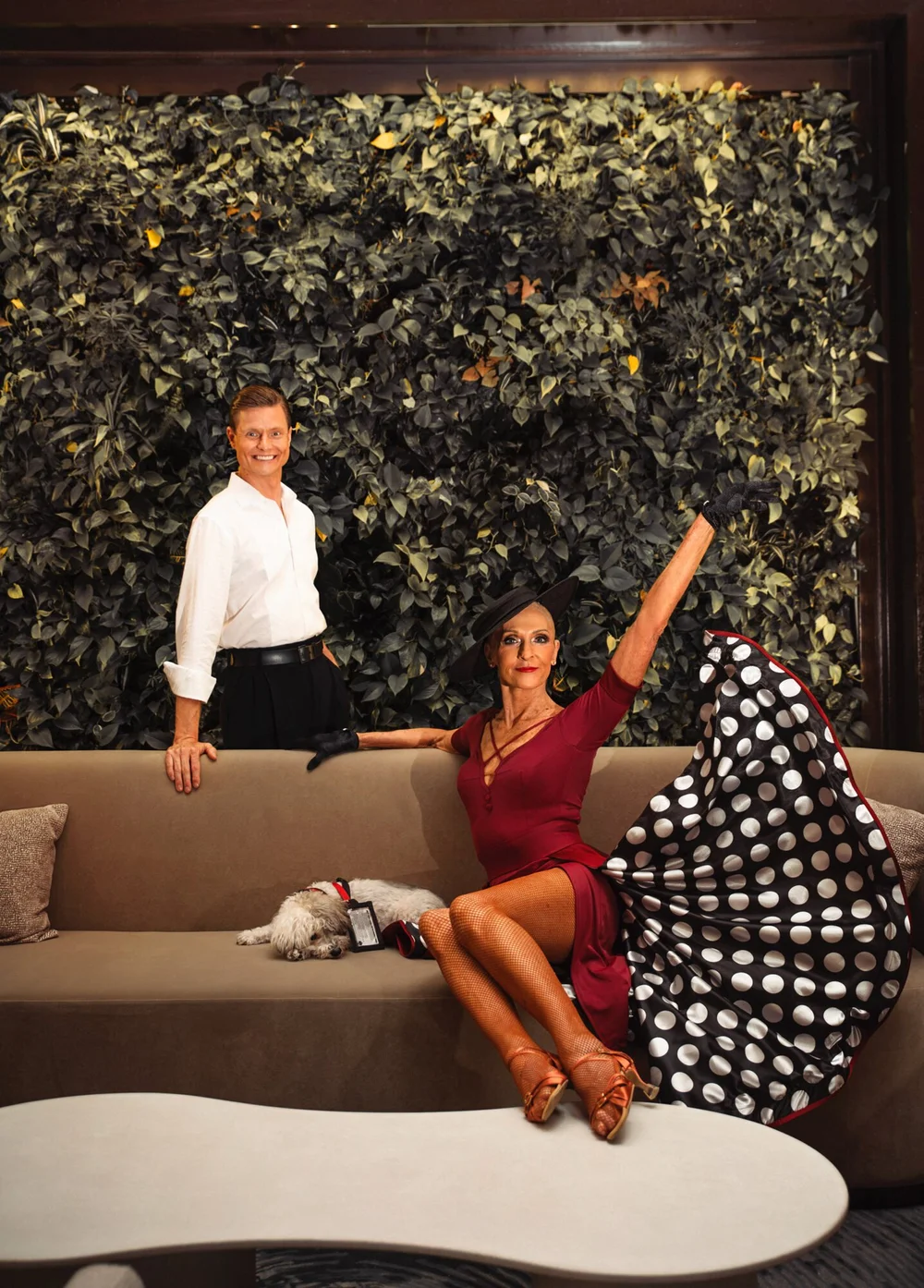
“At first, I had a black belt, but when I saw it on the dress, I wanted a more monochromatic look. So I changed the belt to match the color of the dress. The only contrasting color would come from the polka dots inside the overskirt. Doré added the large polka-dot fabric you see in the final dress. I thought that was the best! Then I found the hat and gloves to finish the look.”
Did the costume affect the choreography?
“Yes, the hat was part of the idea from the beginning. I found so many hats on Amazon that didn't work, and I returned a lot of them. The hat needed to be big, but I also had to be careful with the size. With a big brim, you could hit Mayo while dancing! So we had to be careful with the turns and make sure I could move underneath without the hat getting in the way. It was all a process. But man, it was so much fun! I really enjoyed that!”
How did you decide what Mayo would wear?
“For Mayo's costume, he had to match the era. I looked at a lot of different styles, including sporting looks. I had three possibilities, but we decided that this really cool Dean Martin look would work. That cool, sexy Dean Martin vibe. That's what we ended up with.”
“Mayo had worn the shirt to a friend's vow renewal ceremony in Canada just a couple of weeks earlier. So he says to me, ‘How about, just for memory's sake, I wear that shirt?’ I thought, wow, what a great idea! But then, at dress rehearsal, he says, ‘It feels so weird not wearing a dancer shirt. It feels so bulky!’ He's used to dancing in skin-tight shirts. So there he was, wearing black ballroom pants and an ordinary dress shirt, open at the collar, with his bow tie undone and his sleeves rolled up.”
“He looked so handsome.”
Yes, handsome indeed. The perfect “boyfriend look.”
The Glamour Girl
Tell me, who is the woman you're portraying? She is fascinating.
“My initial thought was, I'm a party girl. I go out a lot, and I'm a glamour girl. But then I'm partying too much. This is the fifties. You have this middle-class lady who wants a little thrill.”
“She goes out to these bluesy jazz clubs to see what's going on. Maybe she has a boyfriend, and he's had it up to here with all this. Because, you think back to the fifties, if you were a proper lady, you didn't go to jazz clubs. You really just didn't. That was my impression of it.”
“So, following the lead from T-Bone Walker's lyrics, ‘Glamour girl, glamour girl, I ain't got no use for you,’ Mayo's character is trying to push me away. But at the very end, I kind of lure him back in, and then we walk off the dance floor together.”
“It is seduction, but flirtatious. Coquettish, I would say.”
By the time we reached the end of our delectable lunch, besides having been transported to the creative world of show dance, my one burning question had been answered. Black Coffee wasn't inspired by Dior, but by the memories and music of the fifties. Dior's influence, however, permeated the fashion of that era, whether consciously referenced or not. He was there, even if his name was not.
The elements of Black Coffee came together through a succession of choices, discoveries, experiments, and collaborations. Some things worked immediately; others had to be reconsidered or abandoned. Gradually, they came together into a cohesive and memorable work of art.
Much as we hope our lives will be. •
Credits & Sources
Photography: Jennifer Bladel
Photography location: Empire Dance Festival
Costume: Doré Designs
Hair: Boyko
From CINDY Magazine, Issue No. 2, Fall 2026. Read the full issue

Roman Malkhasyan
A five-time World Champion in American Smooth on why emotional artistry can start in Bronze.
The Art of Emotion
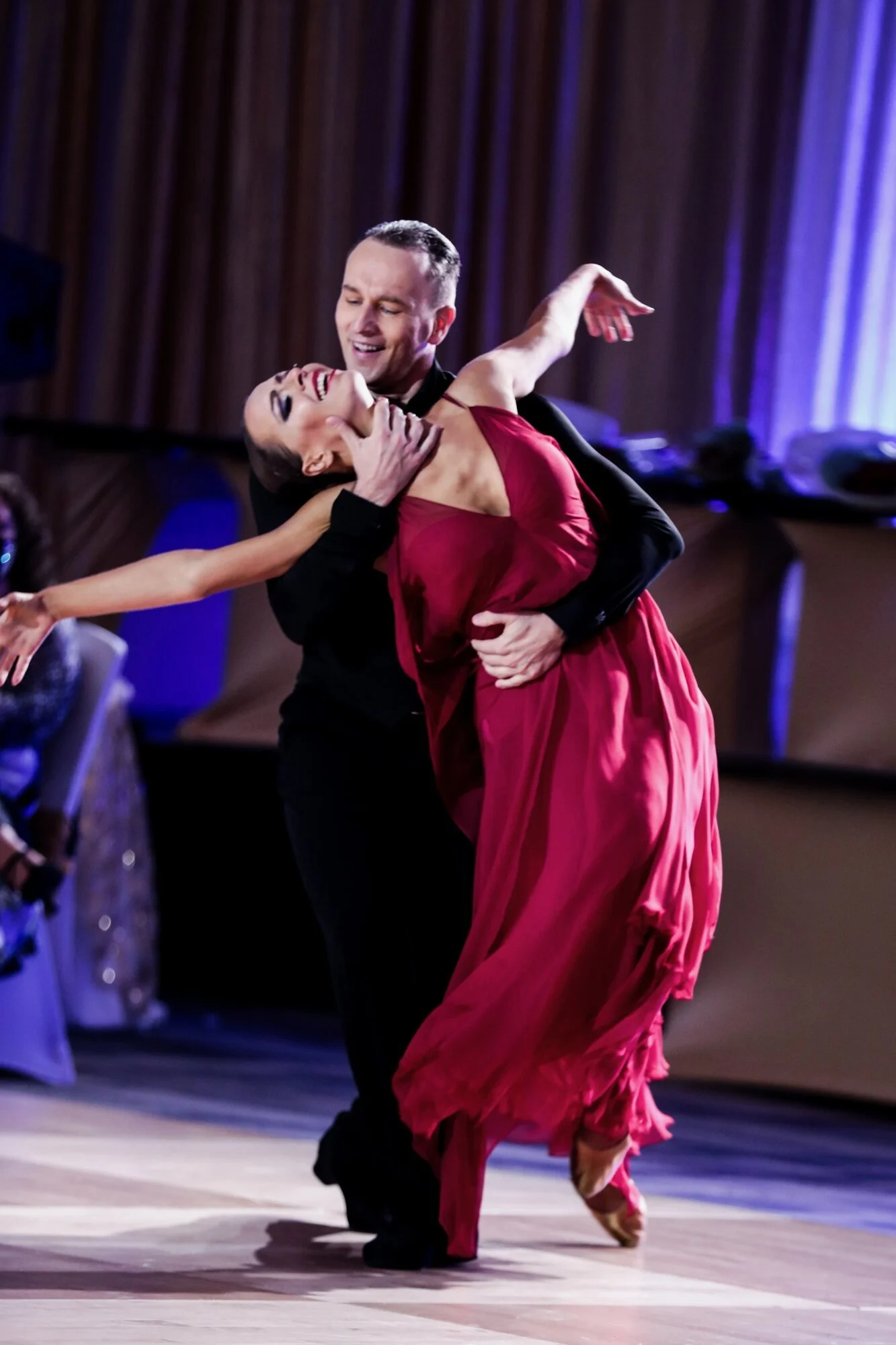
Beyond technique lies another dimension of dancing: the ability to communicate emotion through movement. Why wait until Open Gold? Even a beginner competing in Bronze can start exploring the emotional artistry of dance.
I had imagined that someday, when I reached the Pro-Am Open Gold level, I would devote more attention to developing my emotional artistry. Roman Malkhasyan, a five-time World Champion in American Smooth, challenged that thinking. Why wait?
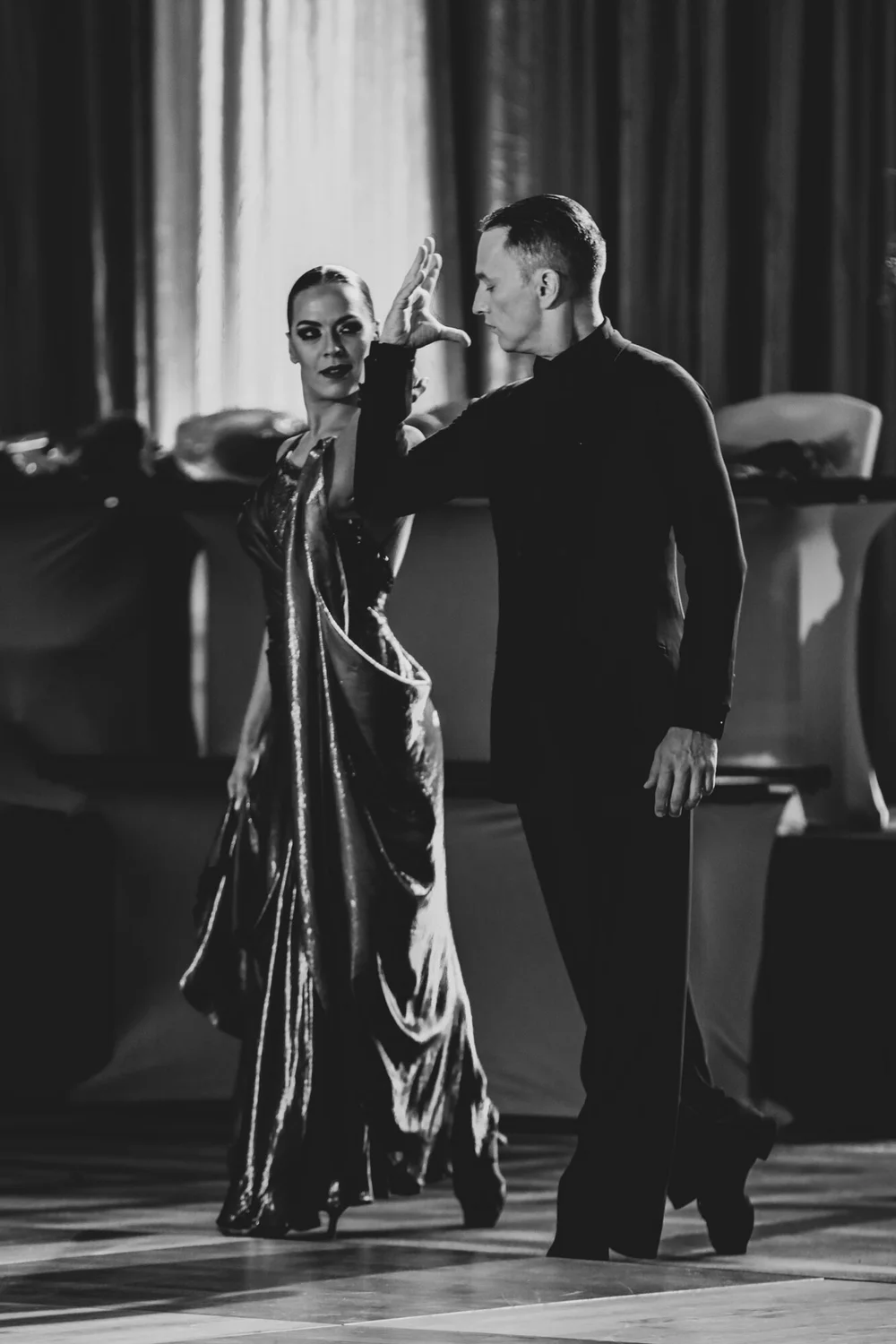
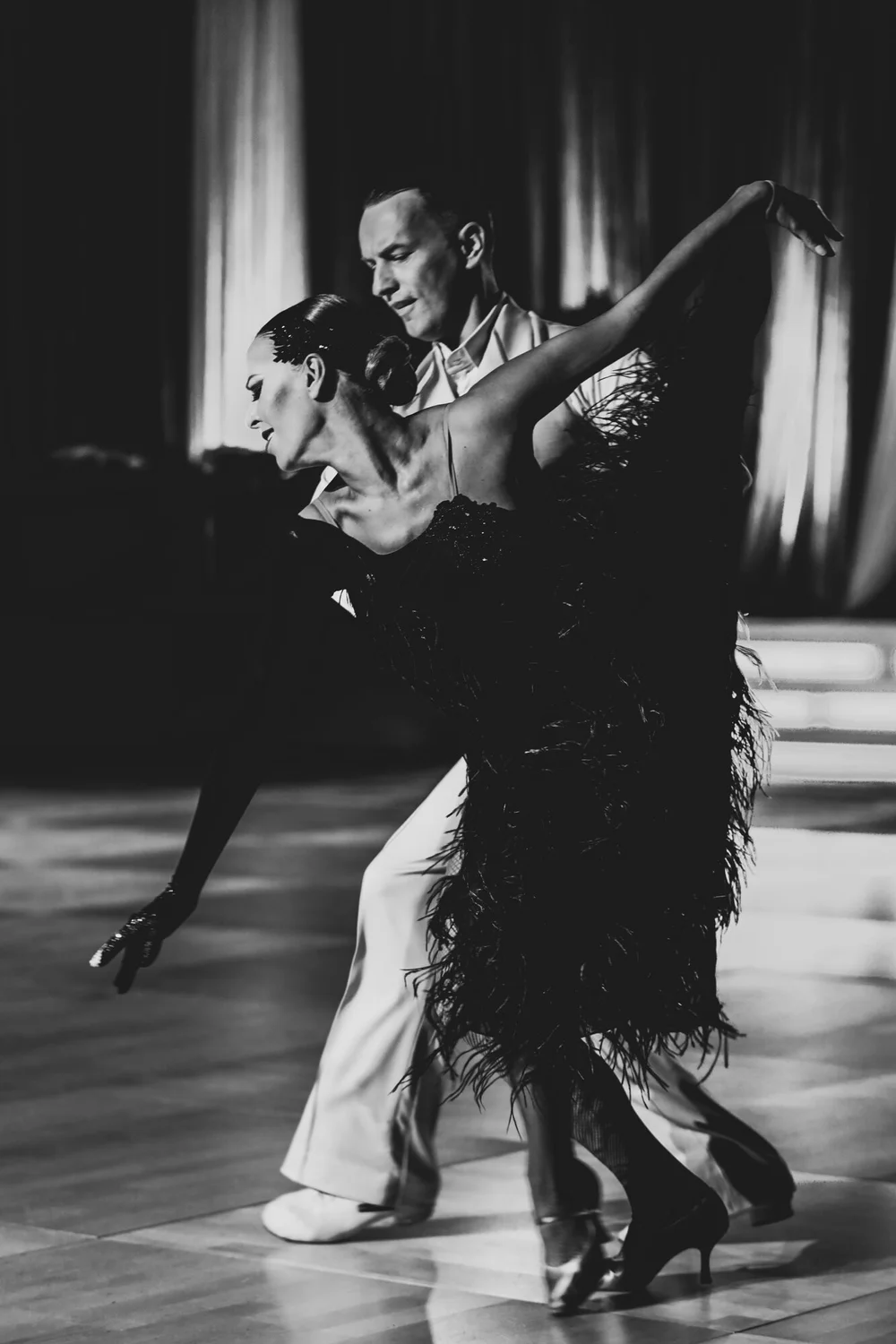
Watching Roman Malkhasyan and his beautiful and talented dance partner Galina Detkina dance, I am always struck by the emotional range they bring to their performances.
Roman believes that even a beginner competing in Bronze can develop an awareness of emotion while dancing. When I asked Roman what he would look for when judging Bronze competitors, he emphasized technique, certainly, but placed even greater importance on whether the dancer appeared to be having a good time.
So, is this where emotional artistry begins? Enjoyment is itself an emotion. If I finish a dance, return to my table, and can say, I was happy out there. I really enjoyed that waltz, then I have begun to recognize what I felt while dancing. That awareness may be one of the first building blocks toward developing a broader emotional repertoire.
But it is one thing to look emotional while dancing. It is quite another to develop the emotional range that allows a dancer to communicate what the music evokes.
How does a dancer move beyond happiness and learn to communicate a greater range of feelings?
Roman believes that emotion cannot simply be borrowed from another dancer. Copying a professional's facial expressions or gestures does not necessarily communicate anything genuine. As he puts it, “Every emotion has to be born through movement.”
The music has an important role in this process, stirring feelings that we can explore through movement. Roman shared a question one of his teachers asked him years ago, when he was still concentrating primarily on his physical abilities. His teacher asked:
“What do you want me to feel when I watch you dance?”
At the time, Roman was concerned with his speed, his movement, and what he could accomplish physically. He wanted to impress his teacher with what he could do. But the question changed the way he thought about dancing.
It wasn't enough to produce a spectacular movement. He had to consider the emotional impact on the person watching. What did he want that person to feel?
On Nerves and Feeling Scared
Roman says nervousness never entirely disappears, regardless of how experienced a dancer becomes. Even after years of professional competition, he still feels it before he goes out on the floor.
I find it reassuring that even the most accomplished professionals have to contend with these feelings. I had imagined that with enough experience, I would eventually stop feeling nervous before competing. Apparently, even world champions experience butterflies before stepping onto the floor.
And Roman has certainly had his share of moments when he felt unsure of himself.
When he arrived in America after ten years away from dancing, he wasn't certain how much of his training he would remember or whether his knowledge was still relevant. He began teaching at an Arthur Murray studio, where, on his very first day, he was assigned a group class of twenty people.
There was one considerable complication: he didn't speak English.
He recalls that the class was probably a cha-cha. Having trained in International Style, he needed to learn the steps used in American Style. He watched a video of the steps before facing his students.
“I was sweaty,” he recalled, laughing. “I was scared.”
His uncertainty didn't end with that first class. When people later encouraged him to return to professional competition, he questioned whether he was good enough. He was entering an unfamiliar competitive world after years of being away.
I was surprised to hear him describe those fears. So I asked him what he was afraid of now.
“Nothing,” he replies laughing playful. “I did it all.”
Yet that confidence doesn't mean he no longer gets nervous before a performance.
As beginners, we may be standing at the edge of the floor, waiting for our heat to be called, while our teacher reminds us to smile. Smile, smile! Meanwhile, inside, we feel as though we are going to die.
How are we supposed to reconcile those two feelings?
“But when you start, you transform that energy into emotion,” Roman explains. Rather than forcing a smile over fear, “we learn to use what we feel and express it through movement.”
The Emotional Journey
I suppose actually listening to the music would help!
I confess that I have completed an entire round of competition and returned to my table unable to remember what music I had just danced to. It happens. Lost in between running through a dancer's laundry list of things to remember—choreography, frame, technique—the music itself can almost disappear.
The goal isn't to sustain one emotion throughout an entire dance. Roman describes an emotional spectrum, much like life. A performance becomes more interesting when the feelings develop and change.
As in a good story, a dance unfolds through shifts in mood and feeling, taking us on an emotional journey from beginning to end. That journey gives the performance another dimension beyond the steps themselves.
Beyond Technique
Technique remains essential. There will always be another skill to learn, another movement to refine, another detail to improve. But Roman's perspective is that emotional expression should develop alongside those skills, rather than waiting until the technical work is finished.
And what about the judges?
Roman remembers preparing for his first world championship, when he and Galina were competing against established four-time world champions. They were pushing themselves to the limits of their physical abilities, determined to give everything they had.
It was during that period that another lesson about emotion became particularly important. His teacher reminded him that judges, too, are human beings. It wasn't enough to impress them with movement. They needed to feel something.
Judges appreciate technique, musicality, beautiful lines, and movement, but they also respond emotionally to what they see. When two dancers demonstrate comparable technical abilities, the performance that creates a stronger emotional connection may be the one they remember.
Perhaps that is what makes emotional artistry so compelling. We are not simply showing an audience what our bodies can do. We are inviting them to experience something emotional with us.
As Roman put it, “Emotion is a powerful thing. Very powerful.” •
Credits & Sources
Portrait: Courtesy of Roman Malkhasyan
Photography: LaHari Photography
From CINDY Magazine, Issue No. 2, Fall 2026. Read the full issue

The Nuclear Option
A first lesson in connection, courtesy of nuclear physics.

A first lesson in connection, courtesy of nuclear physics.
One early morning in the spring of 2025, I entered the dance studio for my first lesson with the formidable Mayo Alanen.
I arrived wide-eyed, an eager student ready to absorb every morsel of knowledge my new teacher might impart. The first journal entry I have written down in my dancing journal from that day was a lesson on “connection,” a principle fundamental to everything we would do together.
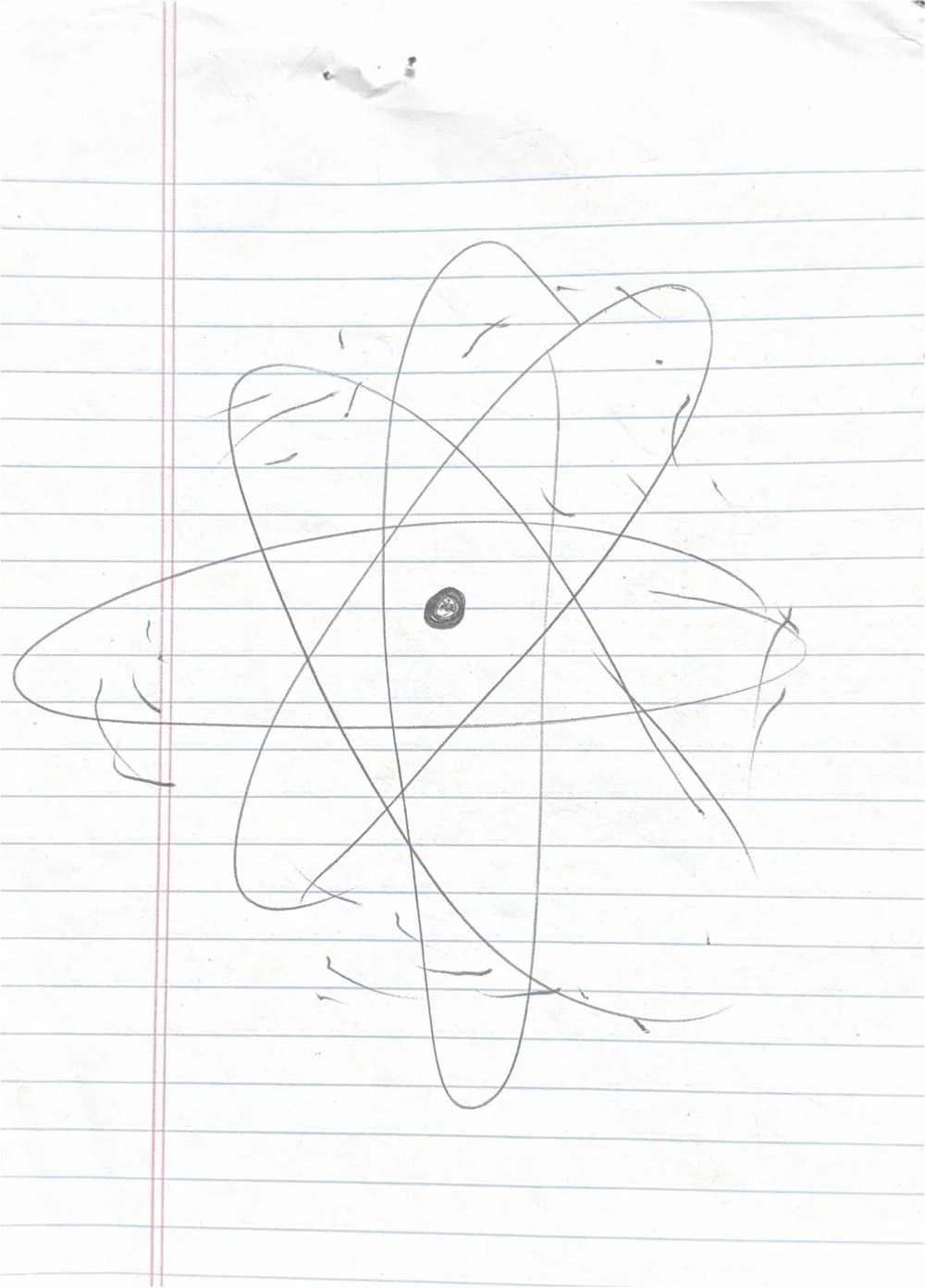
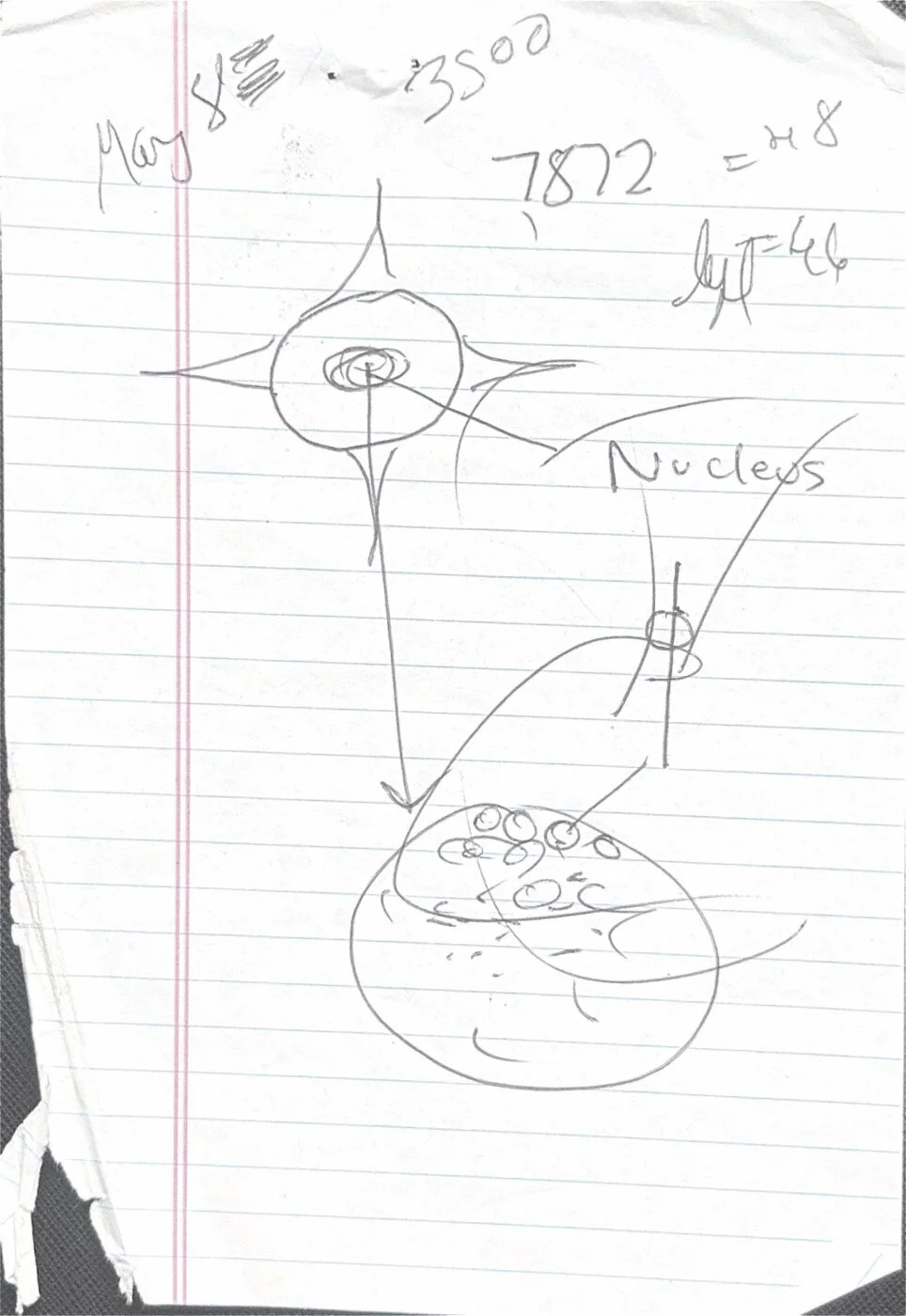
Mayo began by drawing an atom in a random piece of paper. At its center, the nucleus, and inside it, a series of circles representing protons and neutrons, the subatomic particles held together by forces I hadn't contemplated since my high school days.
We were to imagine ourselves as the particles belonging to the same nucleus.
Somewhere between his drawing and the explanation, I became distracted by the images being summoned in my head. I began assigning human characteristics to these subatomic particles. A proton carries a positive charge, while a neutron has no charge at all. The proton seemed firmly committed to being positive, while the neutron remained wonderfully noncommittal. Which one was I? Did I want to keep my options open?
My teacher's voice interrupted my musings. “What happens when the nucleus separates?” Quickly, I searched the answer in distant recesses of my scientific education.
“Uh… I… don't know. Is it bad?”
Very bad, apparently. Nuclear fission. A potentially catastrophic consequence. Think nuclear reaction and the possibility of annihilation.
Oh!
The practical implications of this thought experiment were becoming alarmingly clear. Staying close to my teacher, at a predetermined distance that might vary at any given moment, was now a matter of life or death.
And vary it would.
Connection, I was discovering, was an elusive business. The distance between two dancers changes continuously as they travel across the floor. My responsibility as the follower was to sense the leader's subtlest movements and to respond accordingly, preserving the relationship between our centers. A delicate negotiation of timing, distance, and movement through space. The holy grail of ballroom dance connection.
There would be no uncontrolled drifting, as apparently, the fate of humanity depended upon it.
This first lesson changed my understanding of what it meant to dance together. Two people who are facing one another and performing synchronized steps do not necessarily make a dancing partnership. What transforms the movement into something so captivating that, when you witness it, your eyes are reluctant to wander elsewhere is the dancers’ connection.
The atom would be the first of many inventive analogies my teacher would draw from nature and the world around us to describe sensations that elude explanation. Their meaning gradually reveals itself through your practice at the studio, the occasional choreographed showdance, and the peculiar pressures of competition.
More than a year later, his original drawing remains in my possession, a reminder of that first morning’s lesson and a glimpse of the lessons that lay ahead.
As for what happens to humanity when the dancing couple invades each other's space?
That would be the subject of another lesson in physics. •
Credits & Sources
Illustration: Cindy Gallagher
Original sketches by Mayo Alanen, May 5, 2025.
From CINDY Magazine, Issue No. 2, Fall 2026. Read the full issue

Black Raven
An American Smooth gown in black and metallic blue, inspired by starlings and ravens.
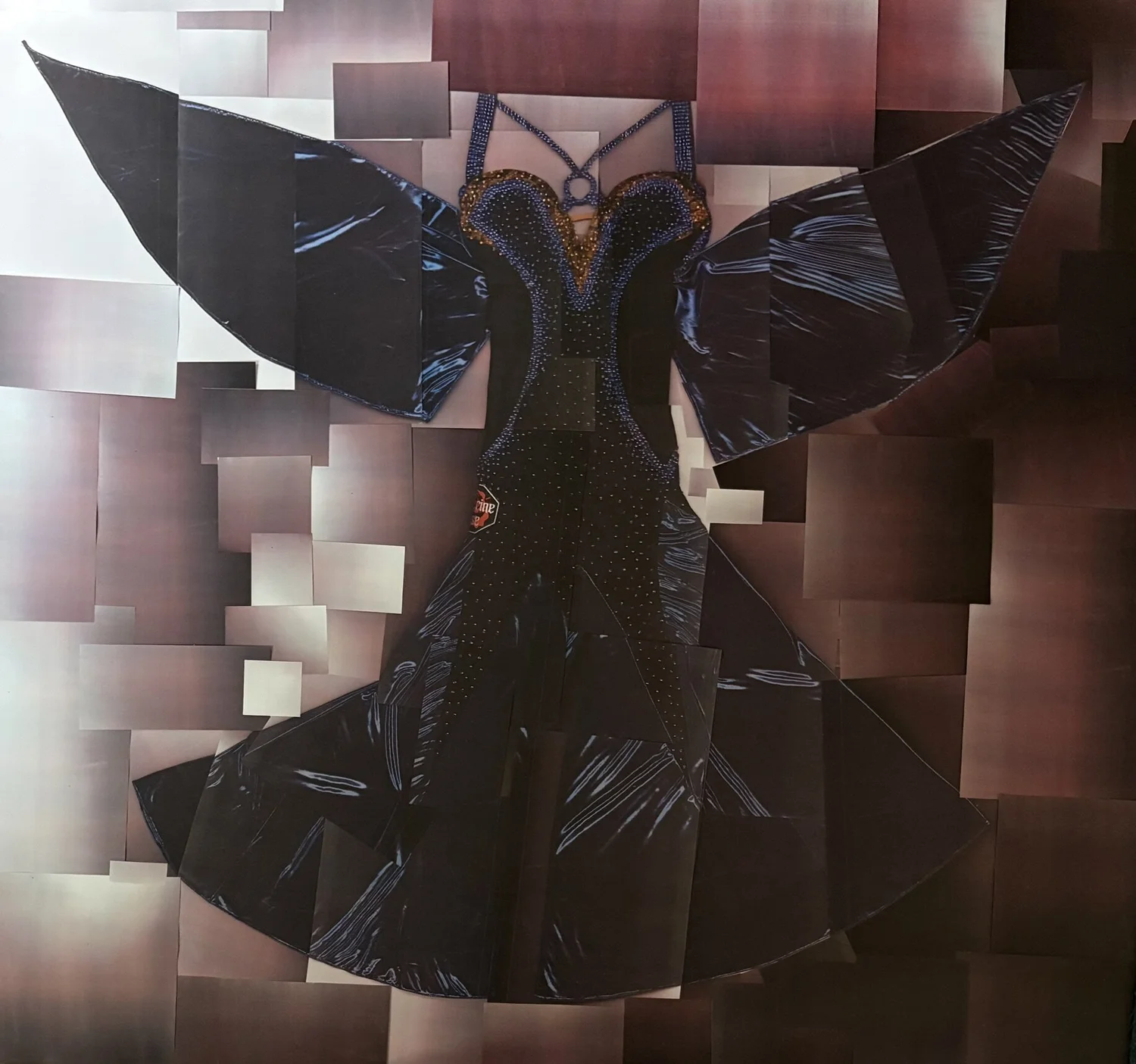
Under competition lighting, fabric extends the body. Rhinestones ignite. Mesh dissolves. Color intensifies beyond what daylight permits. What looks excessive up close becomes precise from across the floor.
This column examines ballroom dress not only for its details and fabrication, but for its function. These garments are engineered for motion, for the amplification of the body, and for the visibility of technique. The question is not why ballroom costumes look dramatic. The question is why they must.
The Dress: Black Raven
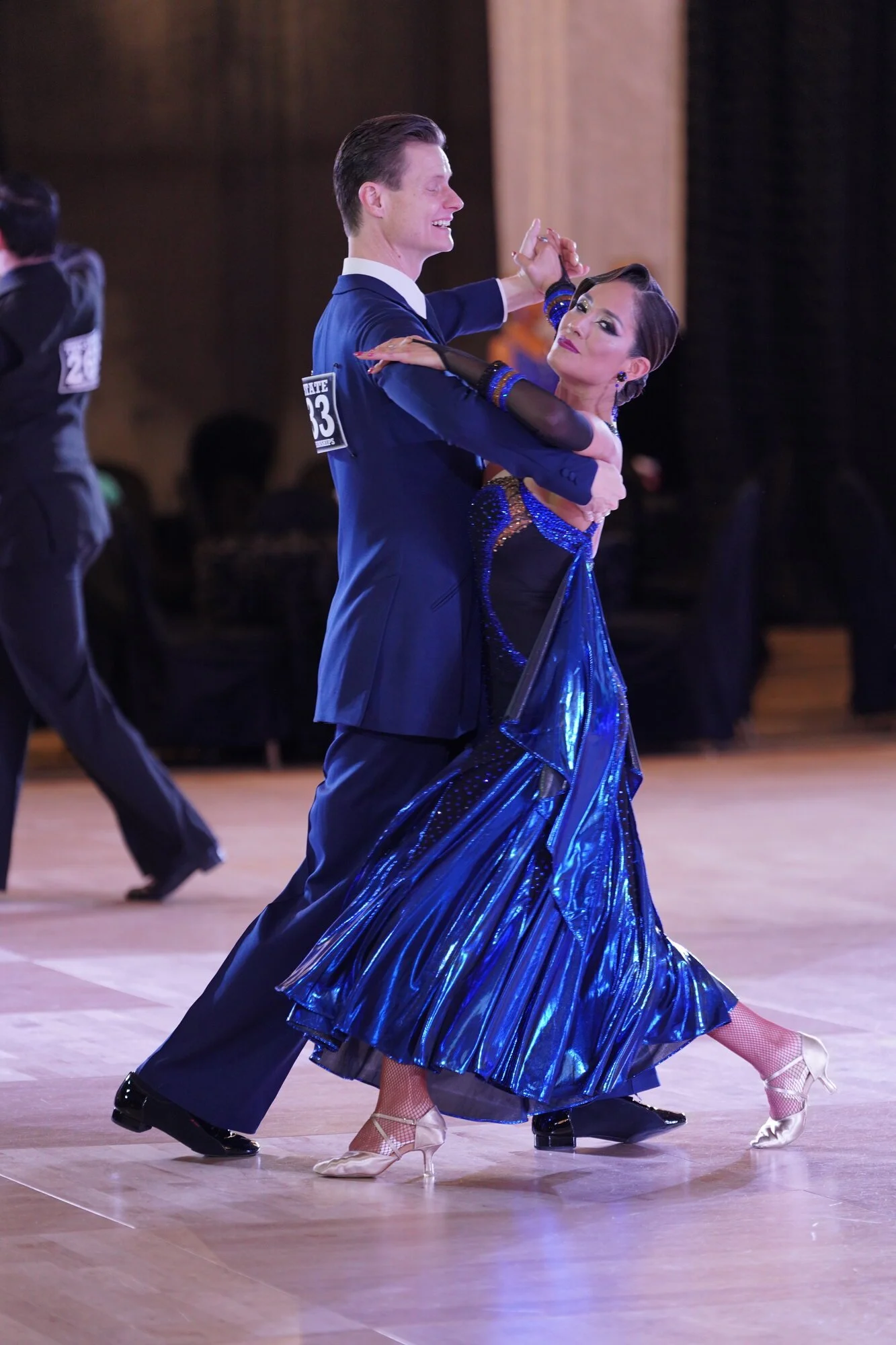
Originally designed for a Pro-Am dancer featured on Bravo TV's Dancing Queens, this American Smooth dress combines black fabric with an unusual metallic blue fabric that the designer*,* Kirtsen, from Catherine Rose Dancewear, had wanted to work with for years, intrigued by its appearance and how it might behave in motion. The result speaks for itself.
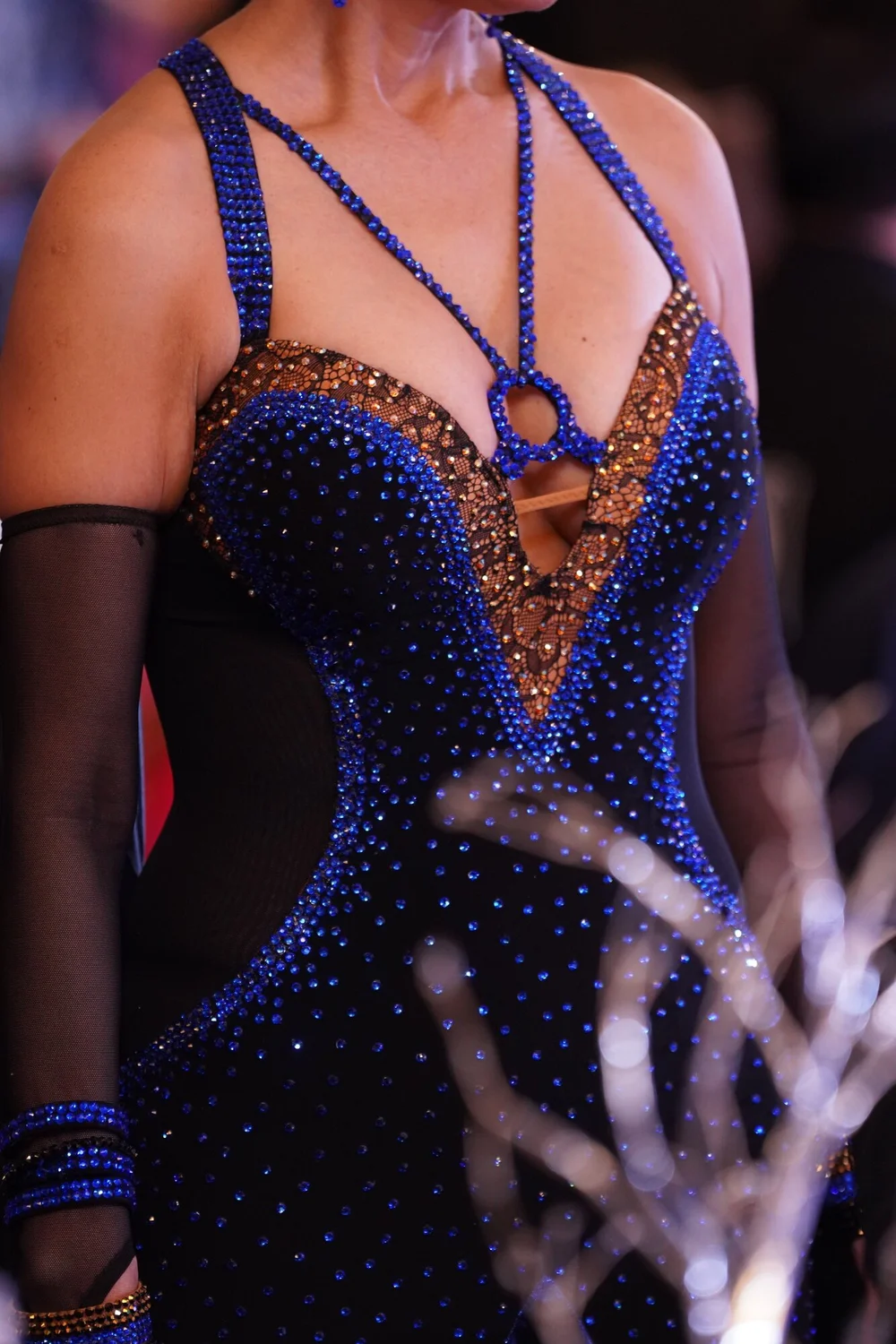
The deep V-shaped neckline is trimmed with an inset of delicate black lace that overlays the flesh-toned bodysuit. Scattered with iridescent topaz-colored crystals, the lace takes on a warm golden appearance. The inset stands out against the dark fabric of the dress, richly scattered with sapphire-colored rhinestones.
The lace is French Chantilly lace, known for its intricate floral patterns, fine netting, and distinctive scalloped edges. It is often used in luxury lingerie.
In its original version, the dress featured a metal ring at the bust. For this reincarnation, however, the ring has been covered with flesh-colored mesh and black lace to blend with the surrounding fabric, then embellished with additional sapphire-colored rhinestones.
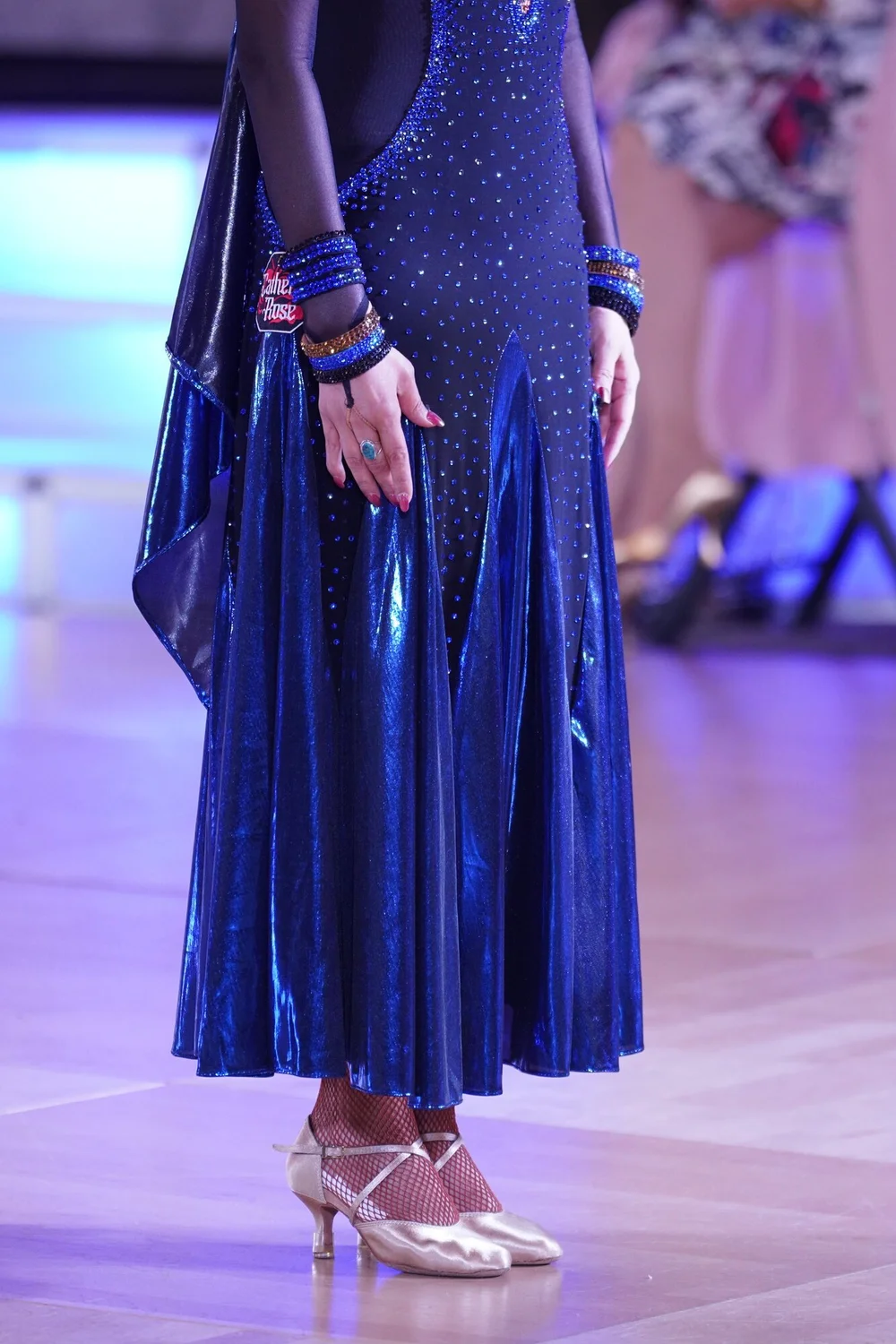
The metallic blue skirt comes alive as the dancer twirls, reflecting the ballroom lights with a shifting brilliance. Its appearance changes with the dancer's movement, revealing flashes of blue against the darker silhouette.
The floats, made from the same fabric as the skirt, extend from the back of the dress, unfurling like wings as the dancer sweeps across the floor, amplifying the movement.
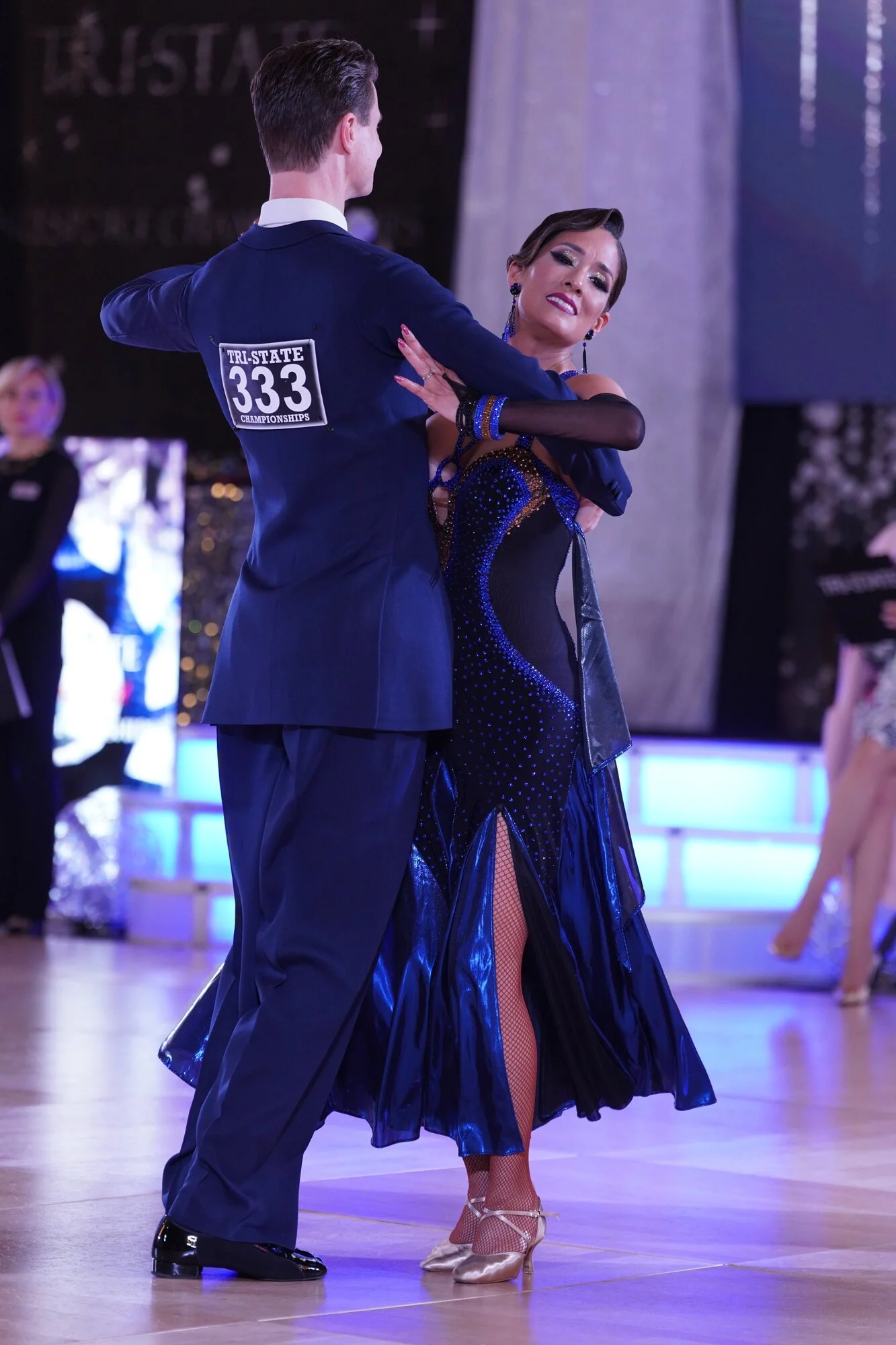
As the dress took shape, the designer drew inspiration from the iridescent plumage of African starlings and jet-black ravens, whose feathers reveal a bluish sheen in the light. Associated with folklore and witchcraft, the raven suggested a sense of mystique that the designer recognized in the dress. She imagined a woman whose femininity carries a commanding presence and strength. •
Credits & Sources
Artwork: Cindy Gallagher
Photography: Dance Production House
Dress: Catherine Rose Dancewear
Suit: MK Style
Hair and makeup: Boyko
Event: Tri-State Challenge DanceSport Championships
From CINDY Magazine, Issue No. 2, Fall 2026. Read the full issue

The Cultural Life
A new column exploring art, literature, film, music, theater, and the creative world of ballroom and beyond. First up: books.
THE
CULTURAL LIFE
Exploring art, literature, film, music, theater, and the creative world of ballroom and beyond. For the curious mind.
A new column · Issue No. 2
BOOKS
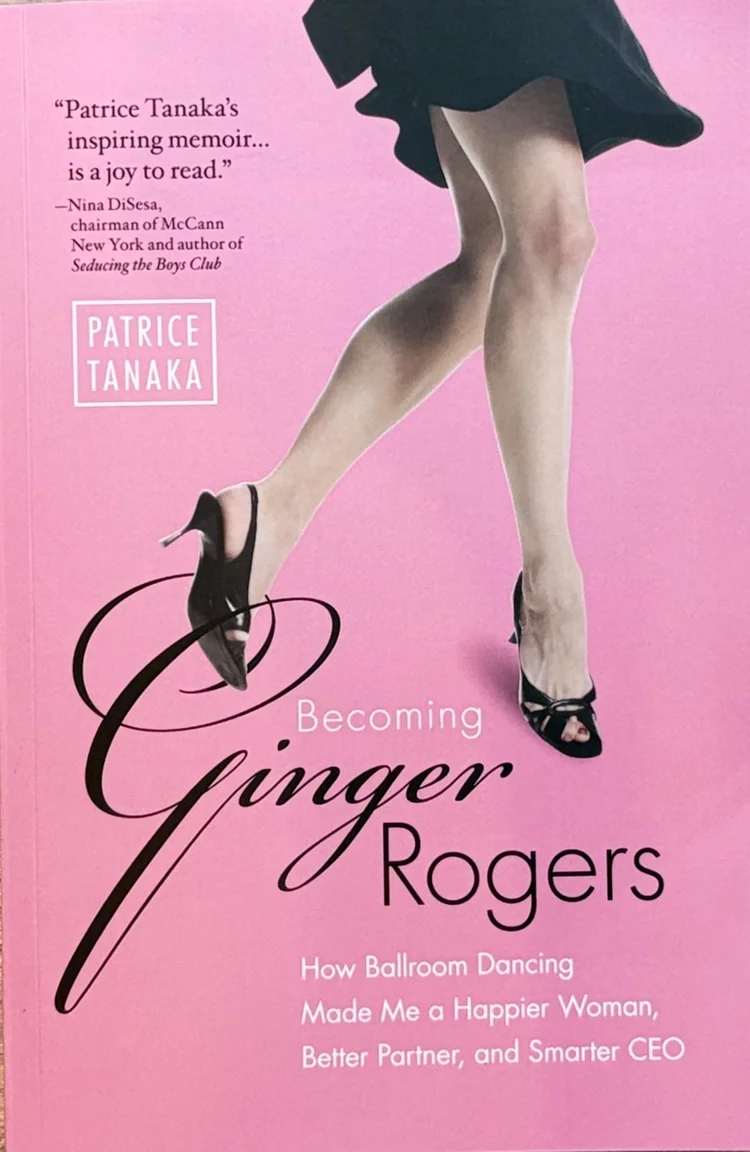
Becoming Ginger Rogers
By Patrice Tanaka
Read an excerpt from Chapter Three in Issue No. 2, free online. •
Credits & Sources
Book: Becoming Ginger Rogers by Patrice Tanaka
From CINDY Magazine, Issue No. 2, Fall 2026. Read the full issue